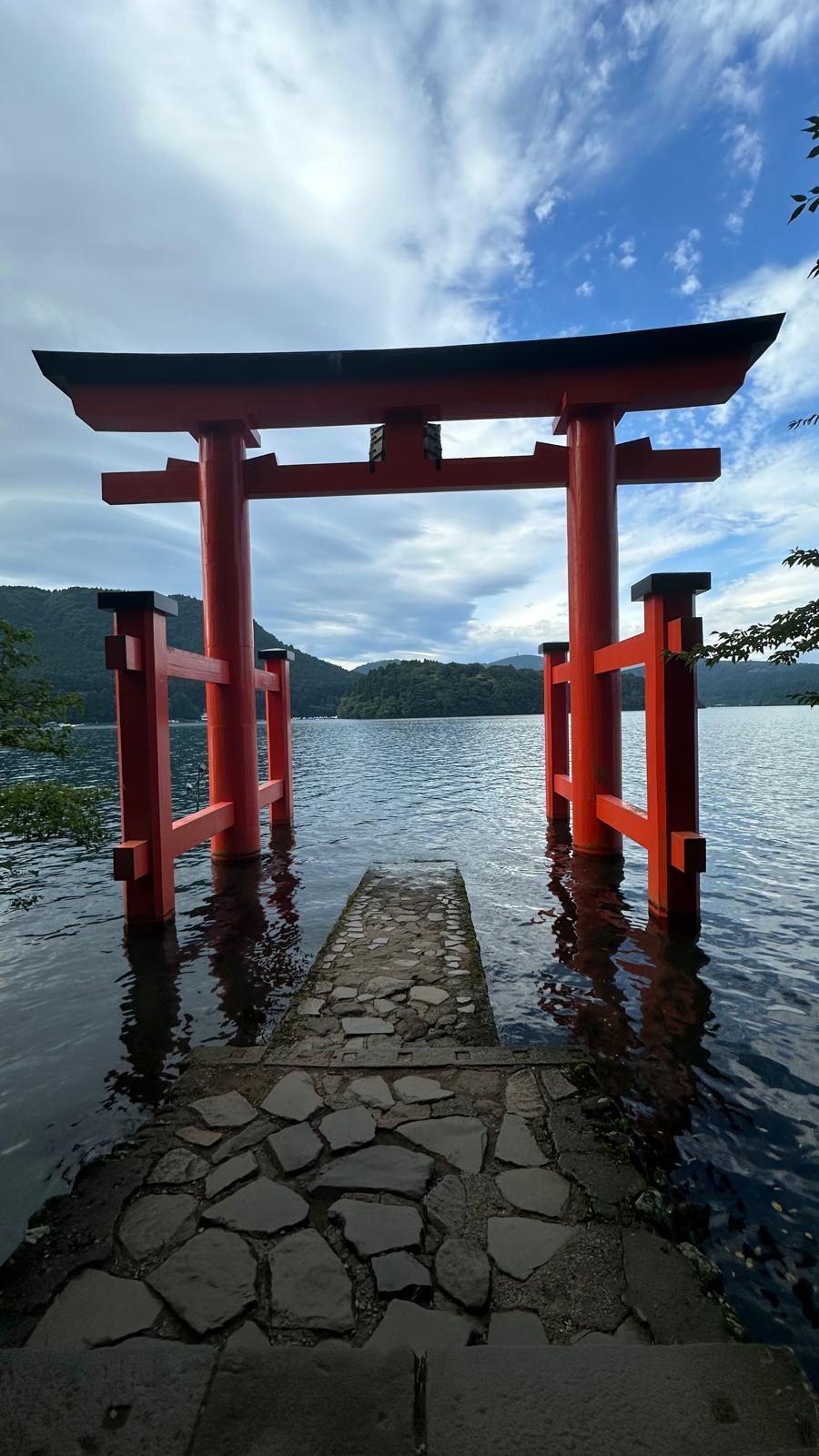
Well, I’m back home!
What did I think of Japan? I loved it! I think what I liked the most is that, since everything is so different, I felt like a kid discovering the world all over again. I’m already thinking about going back!
I was really surprised by how different people are there. You hear about it or read about it, but until you actually go, you don’t realize just how kind, respectful, and helpful they are. If they see you need help, they’ll do everything they can. There are so many people everywhere—it’s hard to imagine before coming. Especially in entertainment places like Universal or the Osaka Aquarium, but also in tourist spots, department stores, train or subway station corridors… Although we did take a couple of crowded subways, I didn’t get to experience something I was expecting: the employees pushing people into the train cars.
Because there are so many people everywhere, there were moments when it felt overwhelming, especially when we were carrying luggage or in a hurry. It’s true that people naturally organize themselves into pathways to avoid bumping into each other, but sometimes they cut across, and it’s easy to stumble. Another thing that stood out was the number of employees in every store or business. For example, when checking in luggage, there was the check-in agent, but behind them was another person just to put the tag on the suitcase and place it correctly on the conveyor belt. Many elderly people work as traffic controllers at crosswalks or garage entrances, or walk around with a bag and long tongs picking up the few things that might be on the ground. These are just examples, but they’re low-skill jobs. I think I read somewhere that their retirement pensions are very low, so they have to take these jobs to get by.
Apparently, they are very different when it comes to eating or social life. While there are places where people socialize more, what I generally observed is that they tend to arrive, eat, and leave quickly so they don’t take up space and make room for the next customers. This makes sense given how many people there are, and also because in many restaurants, people queue outside, waiting for their turn to eat.
They seem to work a lot. You see many people heading home after 7 PM, though some also start work later. I’m talking about office workers—they almost all dress the same: dark or black long pants, black shoes, and a short-sleeved white or light-colored shirt, usually plain. And all of them carry a black briefcase or handbag. Women dress less uniformly.
We often saw kids going to school, even on Saturdays. I think their school year ends in late July—poor kids, with that heat! I guess their classrooms have air conditioning to handle it.
Speaking of air conditioning, its use is massive—it’s everywhere: in subways, stations, hotels, shops… and set at full blast! But then you also find it in unexpected places like elevators, subway or train stations, and even streets (in Osaka, for example, some covered shopping streets have AC). Honestly, it saved our lives because there were days when we had to step into a shop, 7-Eleven, or anywhere every 10 minutes just to escape the heat.
They seem very prepared for the heat. You see people on the street with handheld fans, UV-blocking umbrellas, caps or hats, and many wear a towel around their neck to wipe away sweat when it gets too hot. What’s interesting is that almost everyone wears long clothing—long pants and even long-sleeved shirts. Many women wear sleeves to cover their arms if their clothing is shorter. No low necklines, of course. I guess they dress this way not just out of cultural norms but also to avoid sunburn and skin cancer. According to the signs we saw, they have over 10,000 heatstroke cases per week. It was brutal, and that’s coming from someone used to Spanish summers.
Changing topics a bit—another thing that impressed us was the konbini, which are convenience stores. They’re like the small supermarkets run by Chinese families in Spain, but way better. There’s one on every corner—7-Eleven, Family Mart, Lawson, and a few others. They have everything you can imagine in terms of ready-to-eat food. We used them mainly for breakfast because they have an insane variety of sweet and savory options—onigiri, chicken or pork sandwiches, chocolate pastries, packaged fruit, yogurt… But they also sell crazy things like individual cups of ice, frozen fruit cups that turn into smoothies in a machine… You have to see it to believe it. There’s nothing remotely similar in Spain. They also sell essentials like umbrellas, band-aids, sunscreen… They even rent out power banks—you pay about 1 euro, take a power bank, and return it at another konbini. Plus, they have ATMs with the lowest currency exchange fees.
When it comes to payments, they prefer prepaid cards. There are many types—Suica, Pasmo, Icoca… The one you get depends on where you buy it, but they are now all interoperable. That is, you have to buy the first one in its region, but after that, you can recharge and use it anywhere in Japan. It’s hard to get a physical one because they’ve stopped selling them due to supply shortages, but I got a virtual one in my iPhone wallet. Topping it up wasn’t easy because my bank card was rejected, but it worked with Revolut (Visa). I could recharge it directly from my phone.
For public transport, these cards are super useful. Fares depend on distance, so if you buy single tickets, you need to know the fare (which you either memorize or find on a giant diagram in every station). With Suica, you just tap in and out, and it charges you automatically. Children under 12 pay half, and they have their own Suica cards, but you need to get them at an office.
For tourists who use public transport frequently, these cards end up being expensive. Locals probably use them because they make only a few trips daily. I recommend getting daily metro passes instead—you break even after just four rides. They cost around 800 yen, and a single ride can be 200 yen or even 600 yen if you cross the city. Be careful—metro passes only work for the metro, not for trains, and JR Pass or regional passes are only for trains. A tip: if the line number is inside a square, it’s a train; if it’s inside a circle, it’s a metro. Also, eating or talking loudly on public transport is frowned upon. In the metro, you only hear the train—nothing else. It’s eerie. People either sleep or look at their phones.
For certain trains, you need two tickets—one for the base fare and another for a reserved seat. This applies to medium-distance trains, airport trains, and Shinkansen. For local trains, a single ticket works. Since many train companies exist, you must use the correct ticket machine. We had an issue going to Hakone because we bought the seat reservation but forgot the base fare ticket. At the destination, we had to pay the fare difference plus a 1,000-yen penalty.
Another challenge was exchange orders—QR codes you get when booking train tickets online (I used Klook.com, which lets you book over a month in advance from outside Japan). You can’t use these QR codes at turnstiles—you must exchange them for physical tickets at specific machines for each train company.
In general, public transport was stressful—despite a unified turnstile system, each company has different rules. And since I tend to stress about missing trains or flights, this was the hardest part of the trip for me.
The best way to navigate transport is Google Maps. It tells you everything: the nearest metro entrance, intermediate stations, transfers, fares, departure times, platforms, and even which exit to take. It’s essential.
To use Maps, you need mobile internet. Options include getting a SIM card at the airport, renting a pocket Wi-Fi, or using an eSIM. If your phone supports eSIM, that’s the best option. I used Holafly, which offers unlimited data—just select your trip dates, pay, activate it upon arrival, and you’re set. You’ll need internet immediately for Visit Japan Web, translation apps, and more.
To use Google Maps, you’ll need internet on your phone. You have several options: buy a SIM card at the airport, rent a portable Wi-Fi router with a SIM so you can share the connection across multiple devices, or get an eSIM. It really depends on what suits you best, but if your phone supports eSIM, that’s the way to go. There are plenty of providers, like Airalo or Holafly. I went with Holafly because they offer unlimited data. You just select how many days you need, pay, receive the eSIM, and activate it when you arrive in Japan. You’ll have internet from the moment you land, which is super useful for things like clearing immigration via Visit Japan Web, using online translators, or navigating with Maps. Just remember to disable data roaming on your regular SIM to avoid unexpected charges.
One morning in Nara, I woke up with no internet. Using the hotel’s Wi-Fi, I contacted Holafly via WhatsApp, and they quickly fixed the issue. They told me I had exceeded my data limit (maybe I watched too many YouTube or Instagram videos). They restored my connection right away, but yeah, just a heads-up—it can happen.
Language can be quite a challenge. We barely found anyone (with a few exceptions) who spoke English better than we did—and we’re definitely not C1 level! Most people try their best, but having a proper conversation is rare. I was surprised because I expected hotel staff to speak English a bit better. I assume that in work environments where they deal with foreigners regularly, the level might be higher. For future trips, I think it’s worth learning some basic spoken Japanese. It actually got me interested, so I might give it a shot.
Overall, the food is excellent. Surprisingly, in Tokyo, most places we saw were ramen spots. In Kyoto and Osaka, wagyu beef, breaded chicken or pork cutlets (katsu), and Japanese curry with rice were more common. Sushi places do exist, but they’re not the majority.
In many restaurants, you’ll find a vending machine at the entrance where you select your food and drinks, pay (usually in cash, though some places accept Suica), and receive tickets that you hand to the staff. Then, you sit down and wait for your food—it’s usually super quick. Water is often free, but some places charge for it. In others, you have to order directly from the waiter. Also, tipping is not a thing in Japan. If you try, they’ll probably chase you down to return your money.
- Best ramen – A small place near our hotel in Akihabara with one of those vending machines. It was so good we went back another day.
- Best sushi – Near Ueno Park in Tokyo. This one had table service (lots of pointing at the menu involved! 😂).
- Best curry and pork cutlet – In Osaka, right before visiting the aquarium, at a cozy restaurant run by two elderly ladies.
Eating out in Japan is generally cheap unless you go to touristy spots. We usually spent between 1,000–2,000 yen per person (around 6–12 euros).
Next time, I’d love to stay in an onsen ryokan (traditional Japanese inn with hot springs). This time, we booked regular hotels through Booking.com. Prices were great, especially for the three of us, mainly because Japan allows kids up to 11 to share beds with parents.
We mostly stayed in double rooms, meaning we had to co-sleep. The exception was in Tokyo, where we booked a room with a tatami floor and futons, and in Nara, where we got an extra bed. Most hotels don’t provide extra beds because the rooms are tiny. We managed by pushing beds together, except for the last night in Osaka, where we had a small double bed—cozy but a bit cramped!
On average, a double room cost us around 15,000 yen per night (about 90 euros), which is decent for two people.
Temples sell omamori, which are small fabric pouches meant to bring good luck. They come in different colors, sizes, and designs, each for a specific purpose—health, studies, work, safe driving, etc.
Things you shouldn’t do in Japan: Blowing your nose in public (Once, I wiped my nose in a restaurant, and people gave me serious side-eye), talking on public transport (Trains and subways are silent. It’s out of respect for others and probably so people can hear the announcements), standing on the wrong side of escalators (In Tokyo, stand on the left. In Osaka, on the right. In Kyoto, it’s a free-for-all), eating on public transport (It’s considered rude because others can smell your food), chewing loudly (But slurping noodles? Totally fine!).
Also there seem to be some things forbidden, but they’re not a big deal. Wearing shorts (Most locals wear long pants, but you’ll still see people in shorts, especially tourists), eating while walking (Not really a problem, but if you buy food from a stall, it’s best to eat it there so you can dispose of your trash properly).
Converting yen to euros is pretty simple—almost like using Spanish pesetas back in the day! When we arrived, the exchange rate was around 169 yen per euro, so roughly, 1,000 yen ≈ 6 euros (a little less, but close enough for quick calculations).
In Tokyo, we had no trouble paying by card almost everywhere, except in some metro machines and a few random places. However, we were warned that cash is still widely used in Japan, so I exchanged 600 euros (100,000 yen) through exactchange.com. You request the exchange online, transfer the money, and they deliver the yen to your home within two days. Super convenient, with a good rate. Plus, if you exchange 600 euros or more, they let you convert any leftover yen back when you return.
I’ll keep updating this note as I remember more things!